
02 · The Work3 views
Seven phases. One number.
A round is not one guess. It is seven phases — price, defects, strengths, energy rating, fees, era, then the reveal — and each one moves the number you are committing to. That is the design: valuation is not a single judgement, it is an accumulation of them.
The feed is deliberately social. Listings scroll like a vertical video feed, with likes and a running bankroll, because the format people already scroll is the format that teaches without feeling like homework.
Every price is real. DVF publishes every recorded sale in France; the game is a wrapper that turns that public record into a feedback loop.

Landing + Phase 1GM·CS·01
GM·CS·01
The Front Door & The Guess
One question, asked in the local idiom.The whole proposition in a single screen: real DVF sale prices, twenty arrondissements, free. The three proof points sit under the CTA rather than above it — the question earns the click first. The listing carries exactly what a valuer would work from — arrondissement, type, surface, floor, lift, balcony, view — plus the neighbourhood median per square metre. Then two candidate prices, and no way to move on without picking one.
Use case
A player arrives from a share link and starts in one tap.
No account, no onboarding, no tutorial. The headline states the game, the button starts it, and the legal note about AI-generated visuals sits where it belongs — visible, not hidden.

Higher or lower + Phase 5GM·CS·02
GM·CS·02
Higher Or Lower & The Hidden Costs
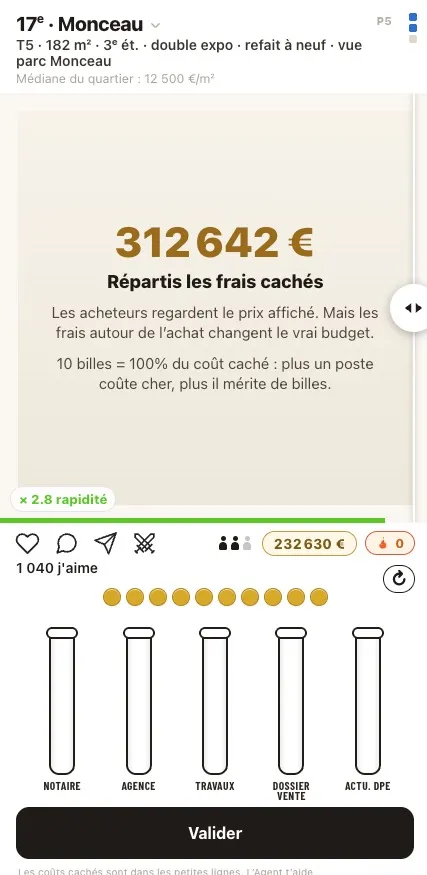
Hesitate and it costs you.A second mechanic on the same listing: a price is shown, and the only question is whether the real one sat above or below it. A countdown bar runs and a speed multiplier climbs, so answering fast is worth more than answering safe. Ten markers, five columns — notary, agency, works, vendor file, energy survey — and the instruction that ten markers equal one hundred per cent of the hidden cost. The more a line really costs, the more it deserves.
Use case
A 182 m² T5 on Monceau, shown at 1 950 000 €.
The multiplier reached 2.3× before the call was made. Speed is scored because a professional valuer does not deliberate for a minute on a property they know — fluency is the point, not arithmetic.
Phase 7 · the reveal and the receiptGM·CS·03
GM·CS·03
The Reveal
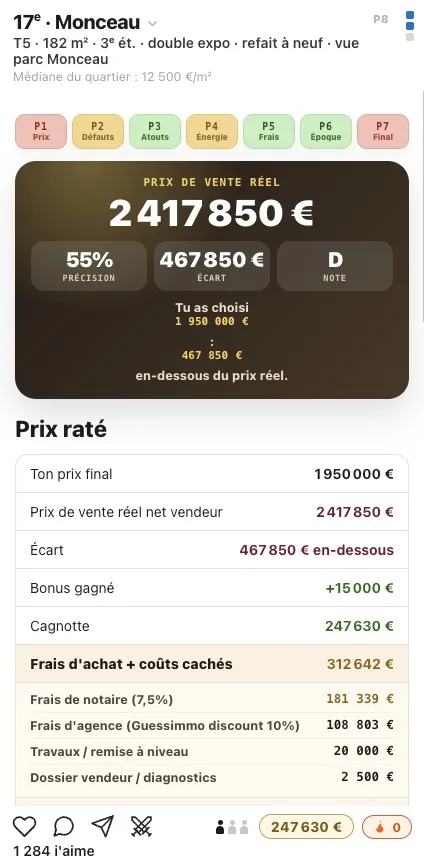
Marked, then explained.The real sale price, the precision percentage, the gap and a letter grade — then the receipt underneath: final price against real net-to-vendor, bonus, bankroll, and every hidden cost itemised down to the diagnostics line.
Use case
55% precision. 467 850 € under. Grade D.
A wrong answer is more instructive than a right one here, because the breakdown shows exactly which assumption was wrong. That is the feedback loop the price engine exists to serve — the game is the interface to it.