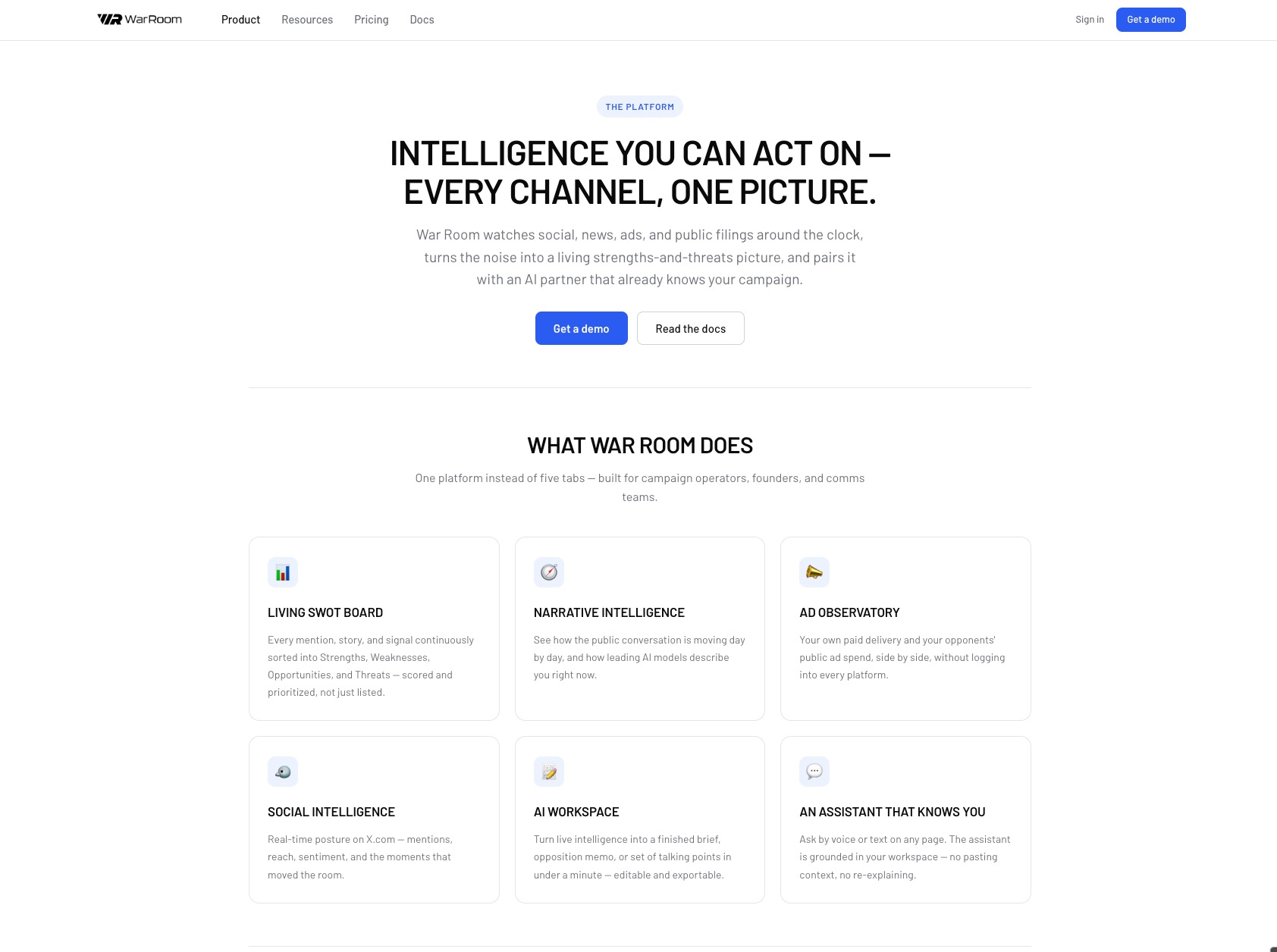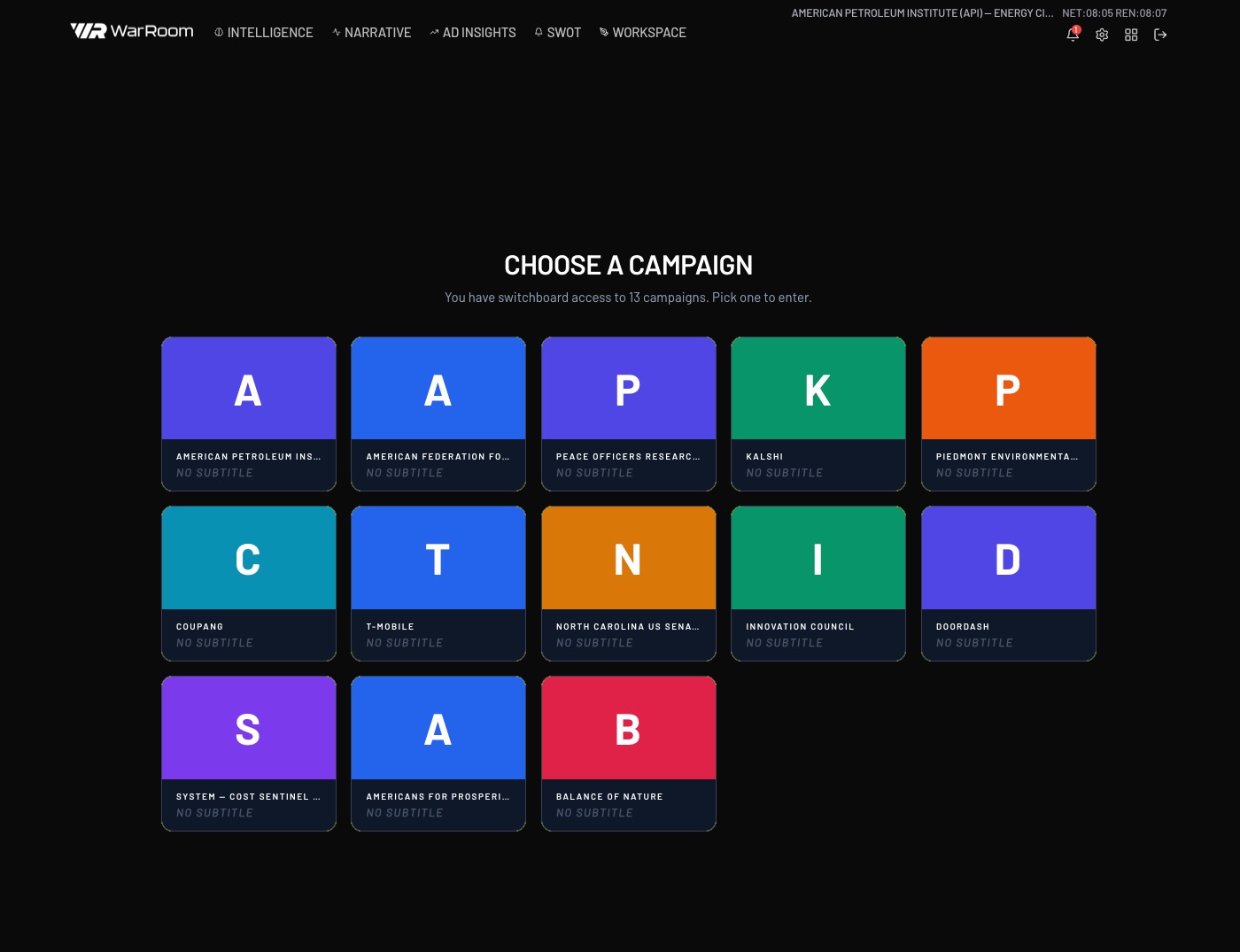
02 · The Platform12 surfaces
What it does.
This is not ChatGPT with a skin on. ChatGPT and Perplexity start every conversation from zero — they know the internet, they don't know you. War Room is the opposite: your data — every mention, story, ad, filing and document you feed it — coming in daily, adapting, re-analyzed over months. What accumulates is a wall of intelligence about your race that can't be bought, scraped or prompted into existence anywhere else. That wall is the moat.
The shape is simple: input, analysis, output. Intelligence ingests the firehose — social, news, prediction markets, your own documents. SWOT turns it into a living picture of strengths, weaknesses, opportunities and threats, scored and re-scored continuously. The Workspace turns that picture back into work product: briefs, memos, talking points, a full branded presentation — in minutes, not mornings.
And it isn't a concept. War Room is in production for lobbyists, lobby groups, trade associations, charities and companies — including big ones — pulling solid MRR today. The surfaces below are what those customers use every day.
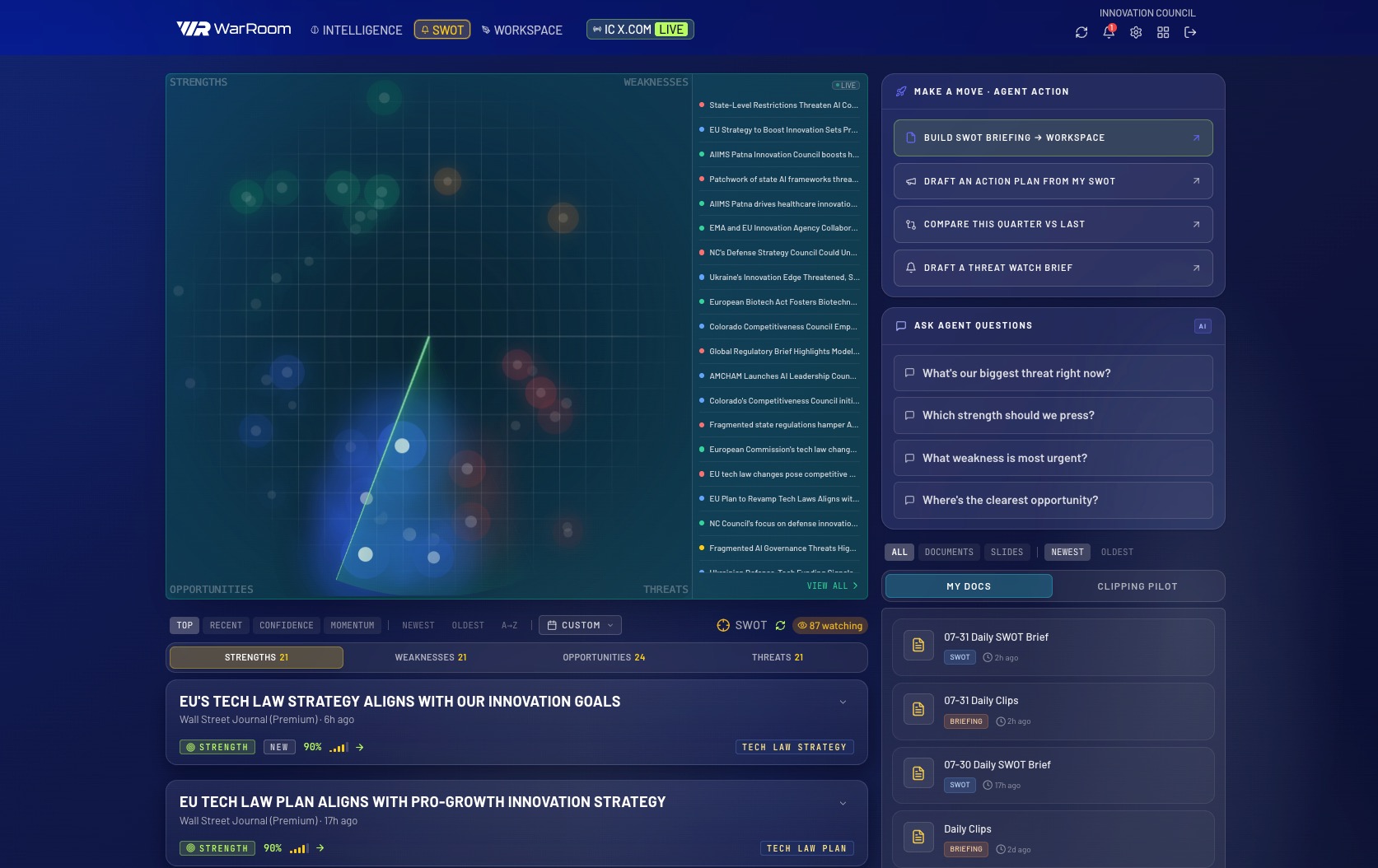
Command Dashboard · SWOT radarWR·01
WR·01
Command Dashboard
The whole race on one screen.Real-time metrics with a SWOT radar — strengths, weaknesses, opportunities and threats surfaced the moment they emerge, scored and prioritized instead of merely listed.
Use case
"Where do we stand?" — answered before coffee.
Monday, nine days out, the candidate asks the question every campaign lives by. The dashboard answers in one glance: what's working, what's threatening, what moved overnight. No fourteen-tab briefing, no analyst scramble — the picture is already on the wall.
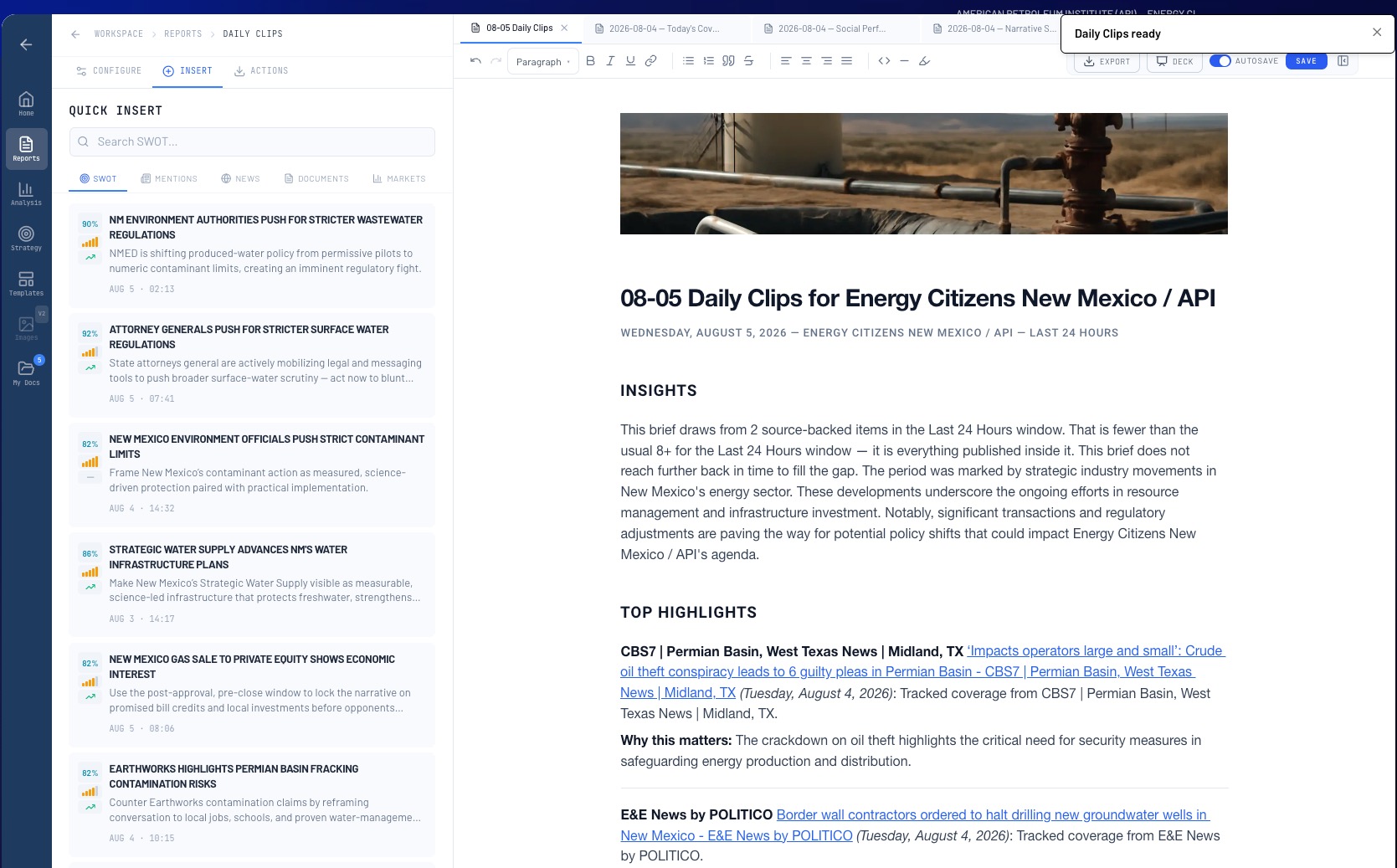
Daily Clips · the day's most relevant linksWR·02
WR·02
Daily Clips
The morning's firehose, pre-read.The daily SWOT brief says where the race stands; directly beneath it, Daily Clips assembles the evidence — every news story, prediction-market shift and social mention from the last 24 hours, scored, ranked and linked in one forwardable document.
Use case
The whole day, one document.
Wednesday, 7am: two source-backed items made the cut — a permitting story and a water-rule shift — each with its link and a "why this matters" line. The client reads it before the staff meeting; the staff meeting starts informed.
Intelligence HubWR·03
WR·03
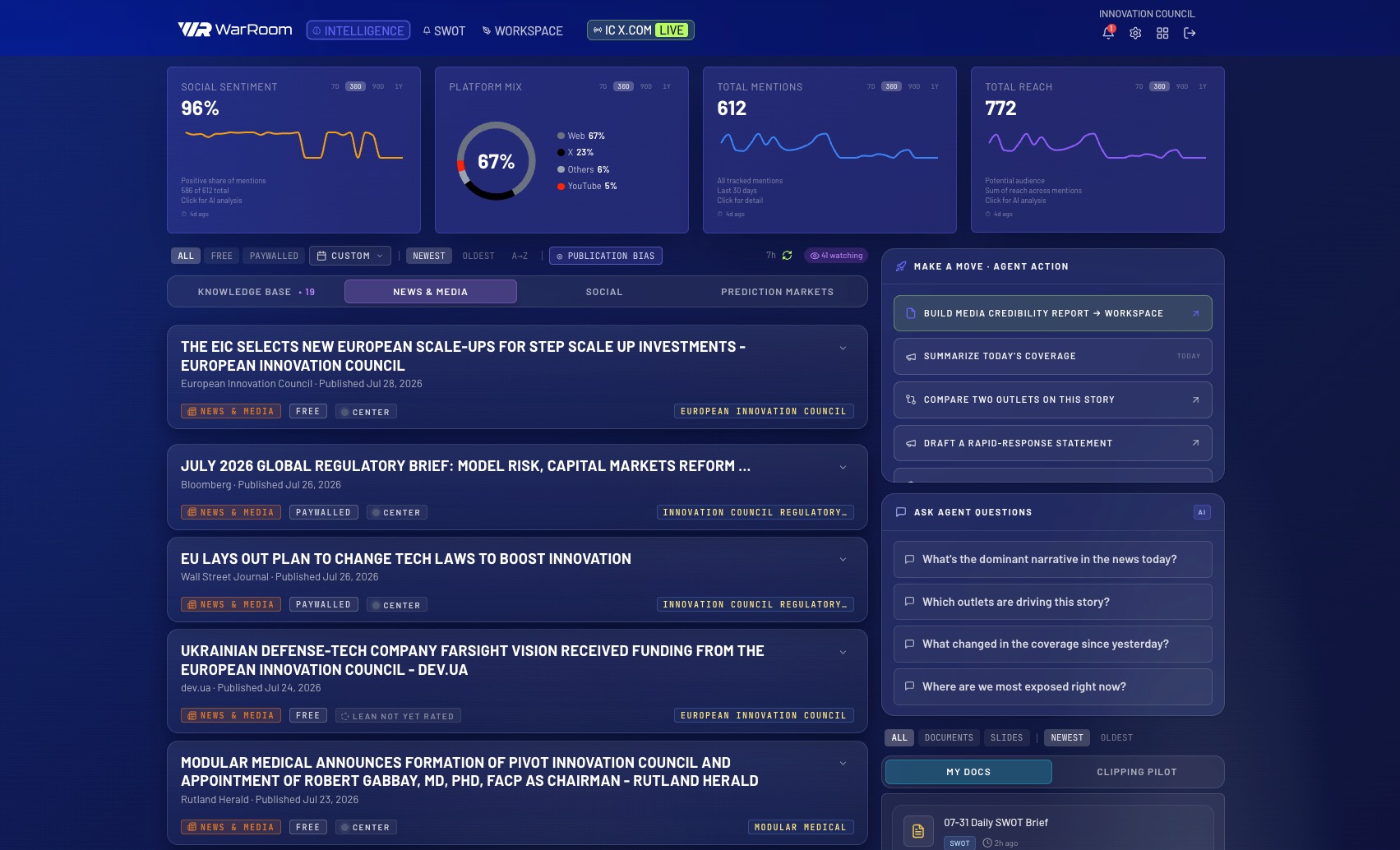
Intelligence Hub
Every channel, watched around the clock.Live social monitoring plus your own documents — the AI reads everything against a knowledge index built from the campaign itself, not from generic training data.
Use case
The story starts on a blog. It's already tracked.
A policy narrative breaks on a niche blog at lunch and jumps to X by dinner. The Hub has read both since minute one — alongside your polling memos and debate transcripts, uploaded weeks ago. The analysis cites your documents, not the internet's guess.
Publish · Publication Bias AtlasWR·04
WR·04
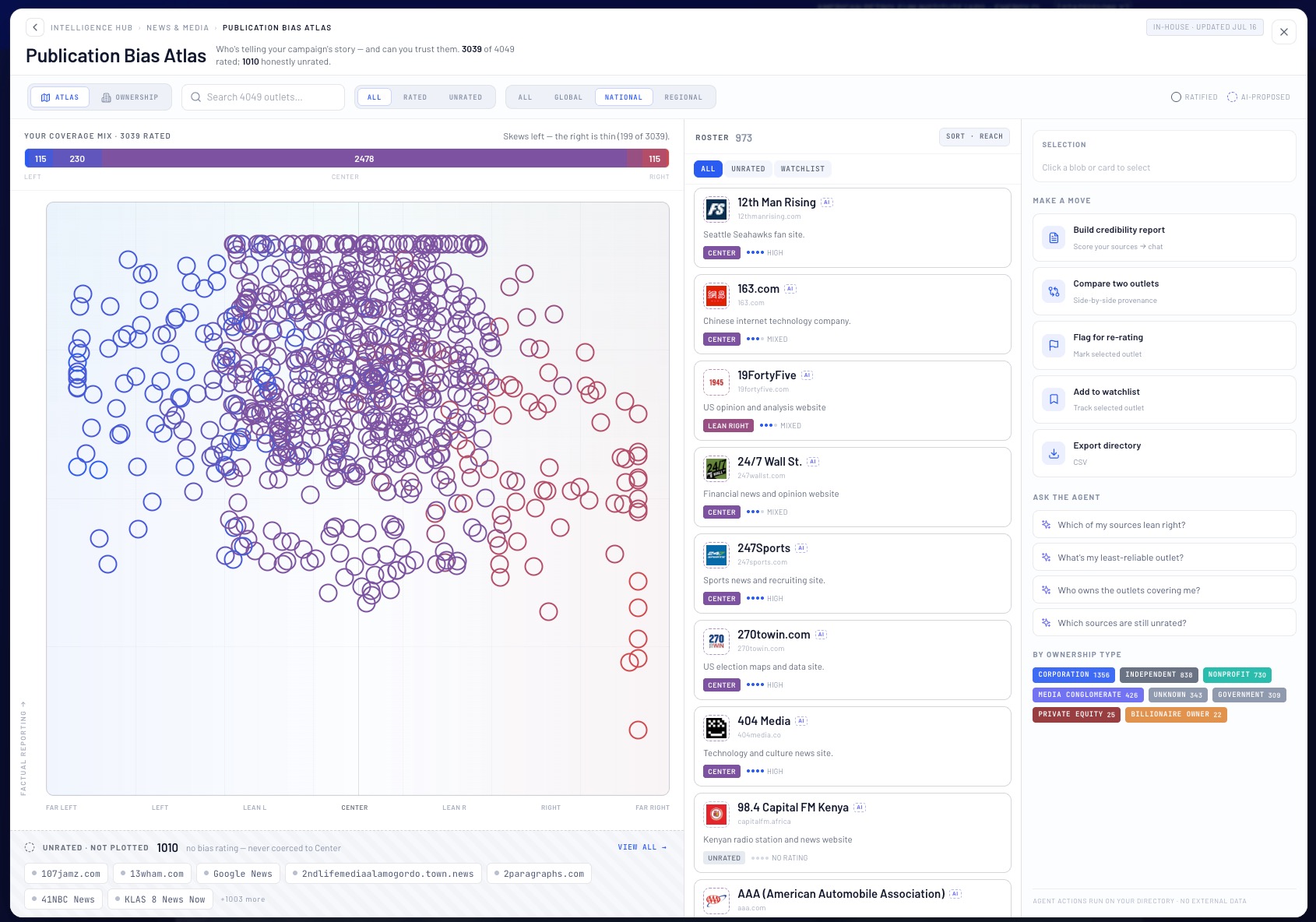
Publication Bias Atlas
Know the messenger.A built-in directory of the press itself — every outlet in your coverage rated for lean and reliability, Ground-News-style, without leaving the platform. When a story lands in the Hub, you already know who is telling it and where they're telling it from.
Use case
"Is this news, or is this their news?"
A hostile-leaning outlet breaks a story about the client. The Atlas tags its lean instantly, so the response is calibrated to the messenger — not a panic, not a shrug, a decision.
X.com DashboardWR·05
WR·05
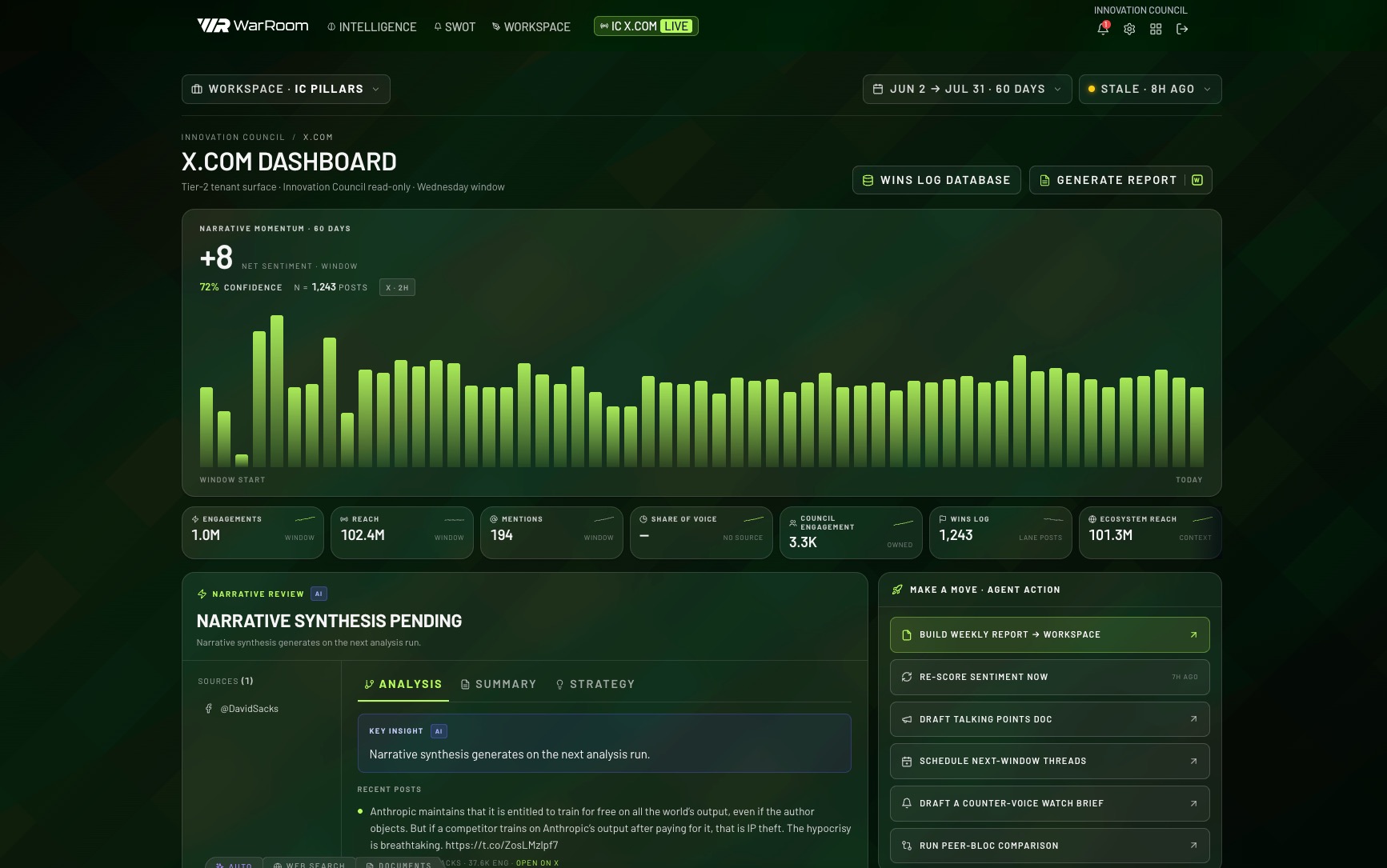
X.com Dashboard
The room's mood, quantified.A dedicated social surface — narrative momentum across any window, reach and engagement at a glance, wins logged, and an AI narrative review of the posts that moved the room.
Use case
Sixty days of noise, compressed to one number.
"+8 net sentiment, 72% confidence, 102.4M reach." The candidate sees the trend before the trackers do — and the weekly report writes itself from the same screen.
Ad Insights · public intelWR·06
WR·06
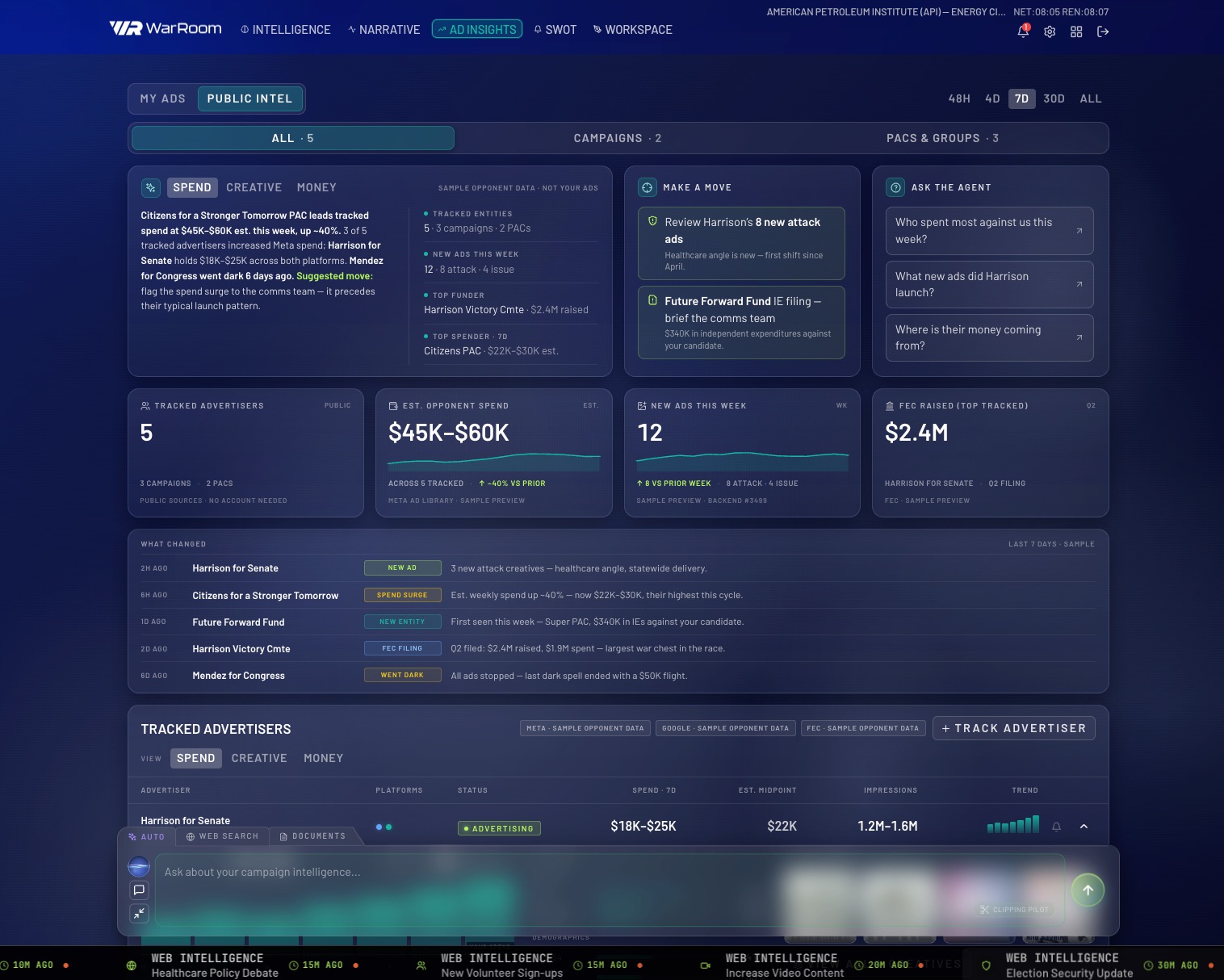
Ad Insights
See the money.Your own paid delivery and your opponents' public ad spend side by side — Meta and Google — without logging into every platform at midnight.
Use case
"They've gone dark." No — they haven't.
The opponent claims silence. Ad Insights shows their Meta spend tripled across three swing counties last week, plotted next to your own delivery. The media buy answers reality, not the press release.
AI Workspace · briefs & reportsWR·07
WR·07
AI Workspace
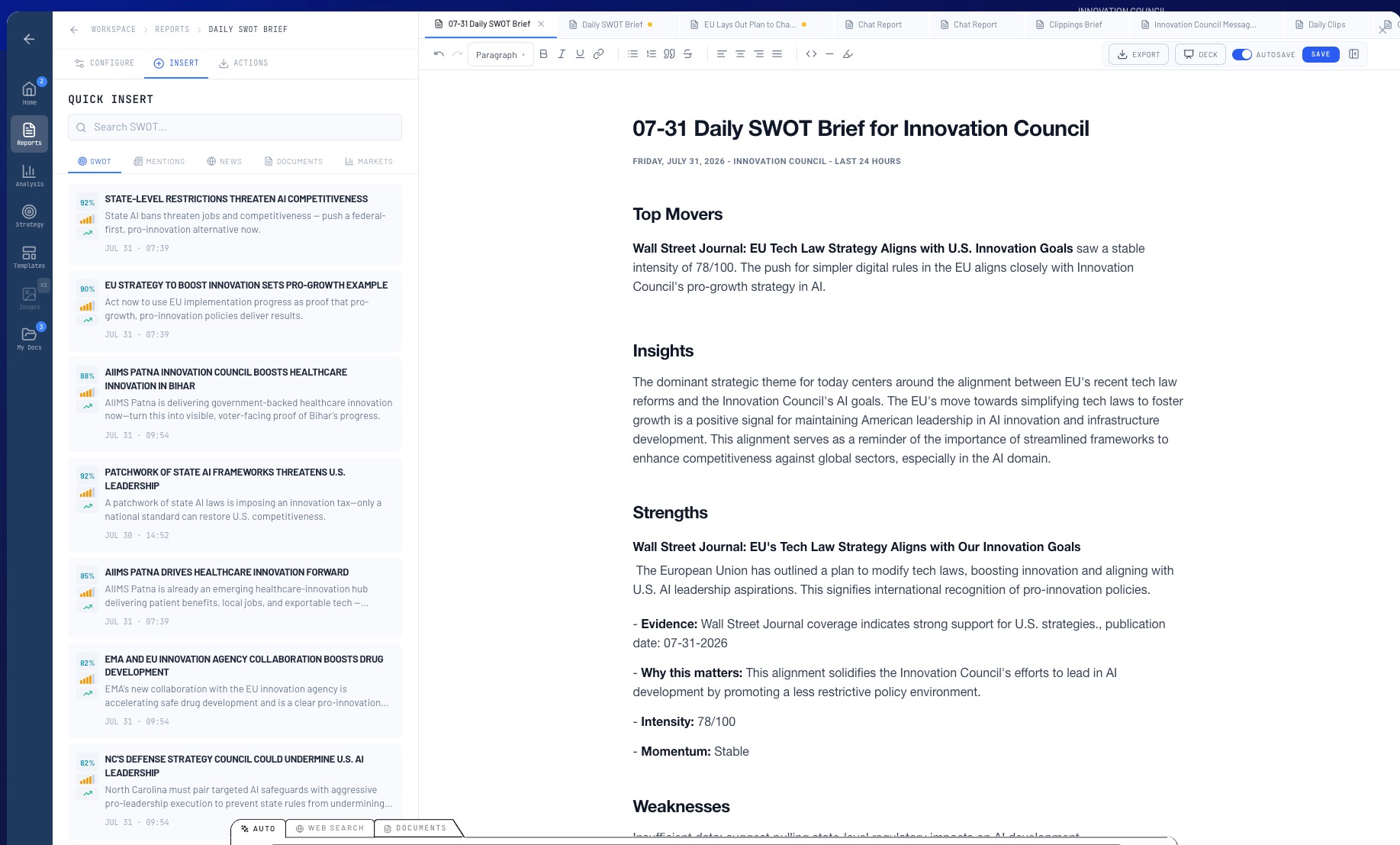
From live intelligence to a finished brief.The output side of the wall. The Workspace turns live intelligence into finished work product — structured briefs and reports you can edit, download as Google Docs, DOCX or PDF, or send straight to a client's inbox by email.
Use case
The Friday report writes itself.
Every Friday the account director exports the week's brief as a branded PDF and emails it to the client before the client thinks to ask. Twenty minutes of review, zero hours of assembly.
Presentations · clip → deckWR·08
WR·08
Presentations
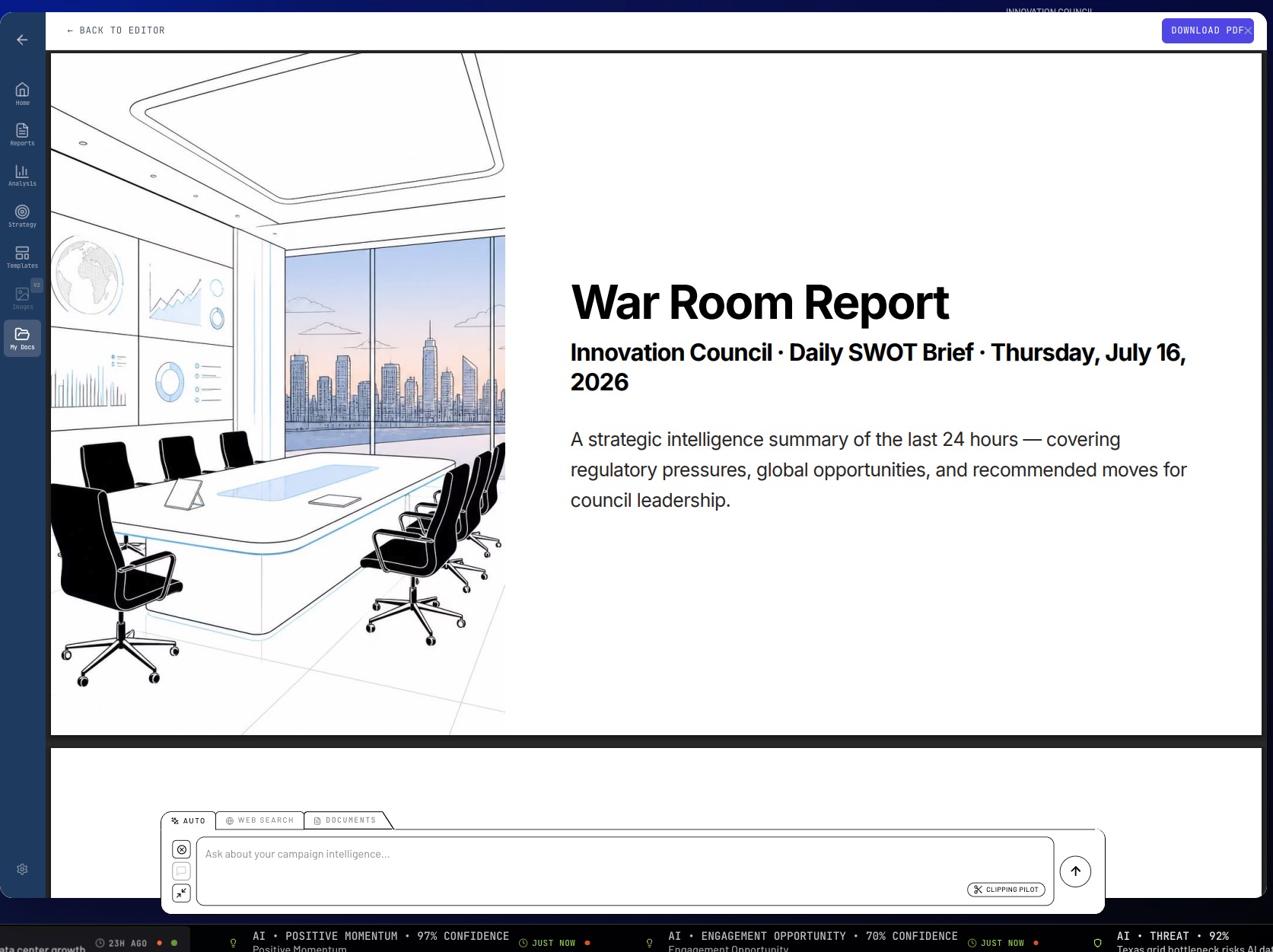
A board-ready deck in ninety seconds.Paste clipped intelligence into the generator and War Room builds a full twelve-page presentation — your logo, your design, every chart sourced from the live index. Not a template with gaps: a finished, editable deck.
Use case
Four hours of analyst work. Ten minutes, start to finish.
Before the board meeting, the director clips the week's sharpest intelligence, pastes it in, and walks out with the deck — the work that used to eat an afternoon, done before the coffee's cold.
Talk & Chat · ask by voice or text, any pageWR·09
WR·09
Talk & Chat
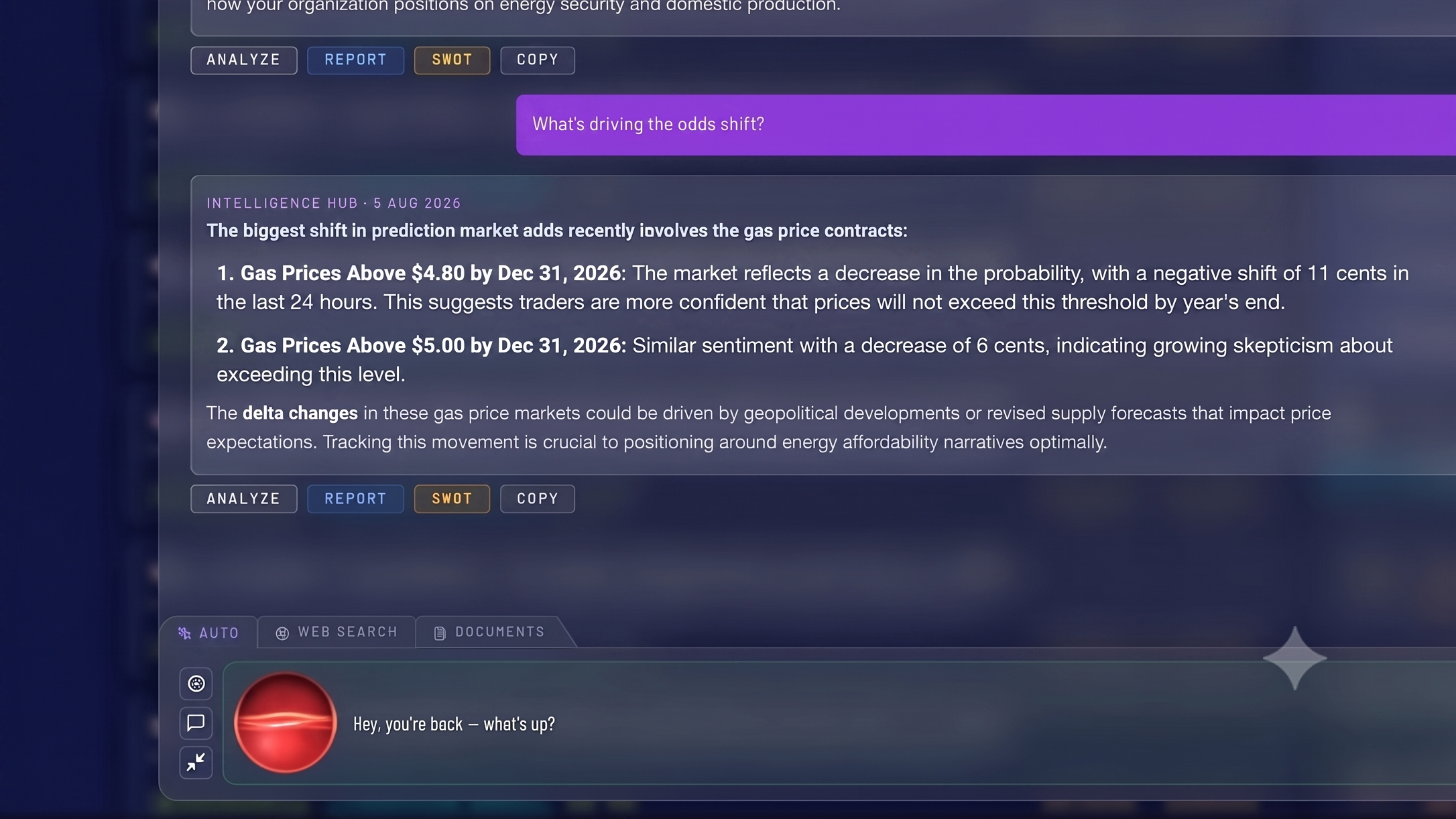
Ask out loud — or in the box.An assistant that already knows the campaign. Ask by voice or text on any page — grounded in your workspace, no pasting context, no re-explaining. Talk reads the answer back for operators whose hands are full; Chat threads it, cites it, and turns it into a deliverable.
Use case
Hands on the wheel — or on the keyboard.
Driving between canvass launches, the candidate asks out loud: "What's the latest on the factory closure?" The orb answers from the live index — sources, sentiment and all — before the next exit. Back at the desk, the analyst asks the same brain in Chat and walks out with the answer cited, threaded and exported.
Switchboard + control plane · sealed, encrypted, 2FAWR·10
WR·10
Multi-Tenant
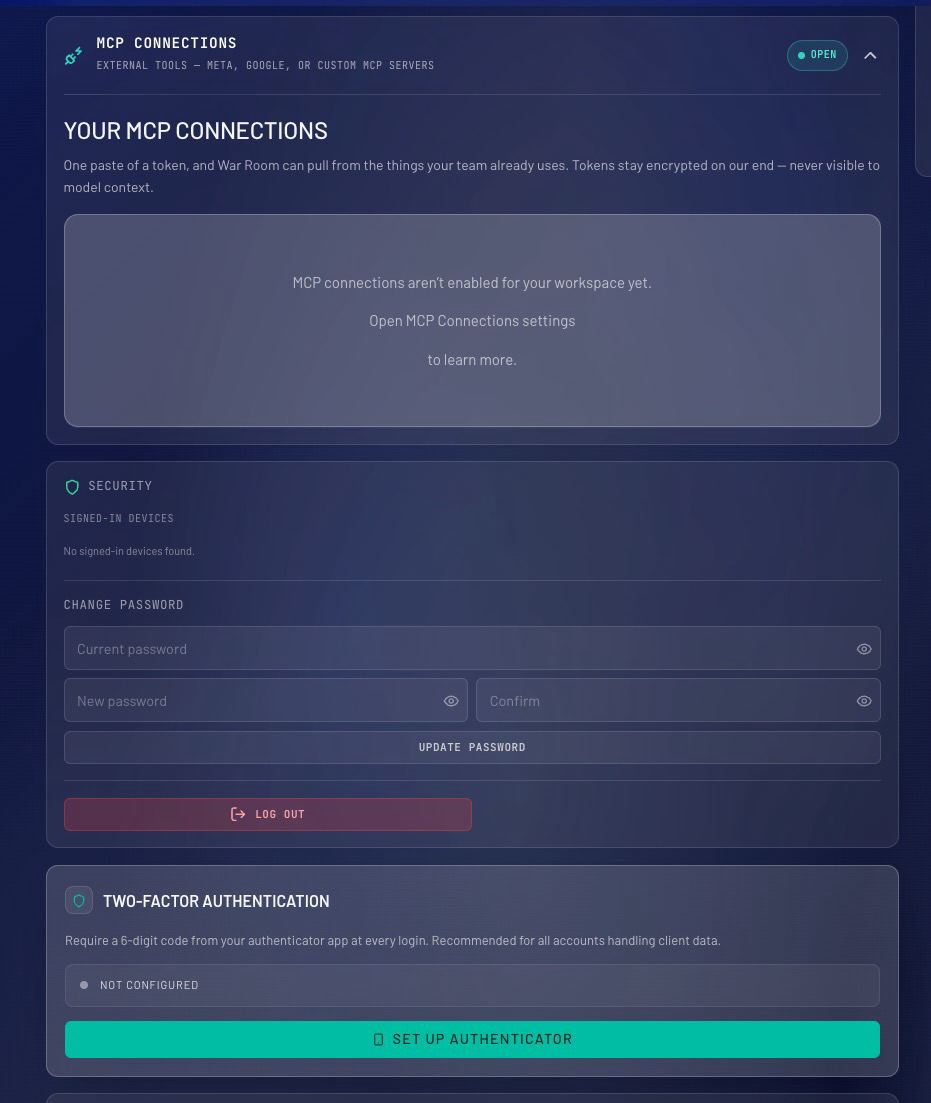
Your campaign, sealed.Every client and campaign runs in its own isolated tenant. Nothing crosses — not data, not memory, not alerts. MCP connections pull from the tools your team already uses — tokens encrypted, never visible to model context — and 2FA on every seat that touches client data. Trust is the architecture, not a promise.
Use case
Five campaigns. Five sealed rooms.
An agency runs a senate race, a mayor's race and three ballot measures. Each gets its own memory, its own alerts, its own agents. The senate race never sees the mayor's data — that's not a setting, it's the architecture.
Operations + admin · costs, health, provisioningWR·11
WR·11
Operations Center
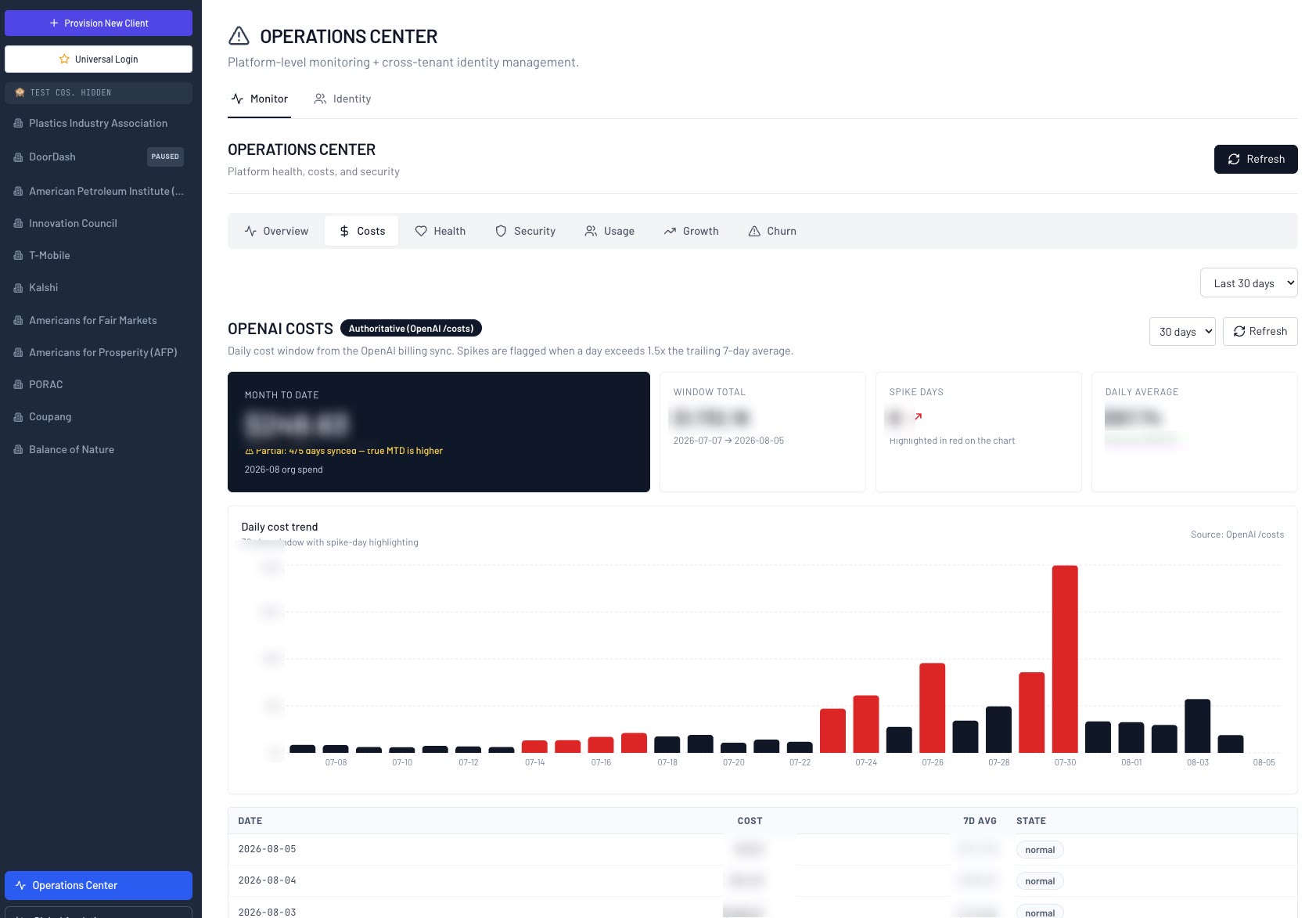
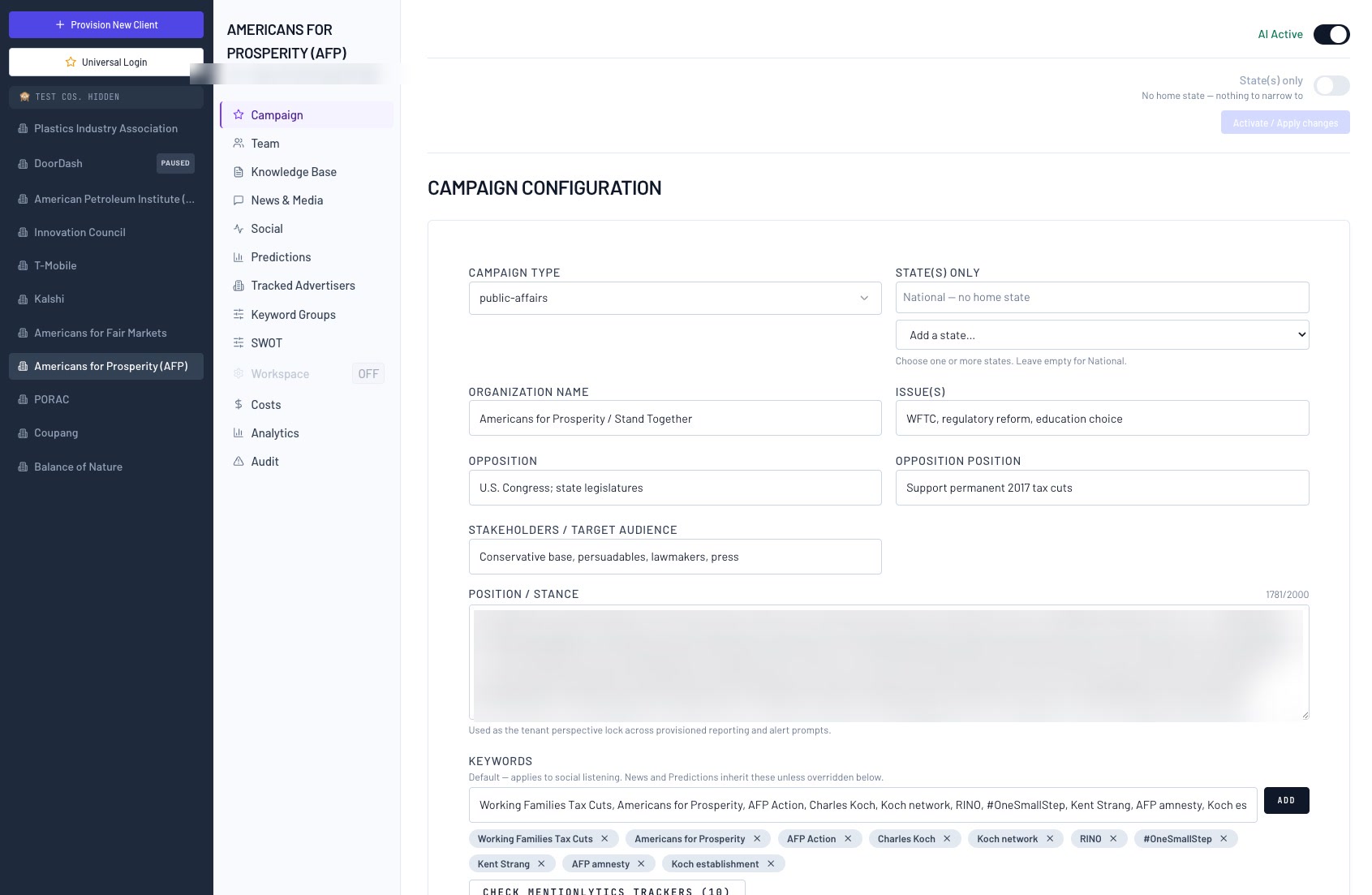
Every token accounted for.Platform-level monitoring: daily LLM spend with spike detection, health, security, usage, growth, churn — the same discipline a fund runs on its money, run on its intelligence. And the admin plane sits right beside it: provision tenants, lock the campaign's perspective, wire keyword groups and trackers. One panel between a signed contract and a live war room.
Use case
The $356 day is flagged before the invoice lands.
A daily cost window exceeds 1.5× the trailing average and turns red on the chart. Nobody discovers spend on the invoice — the platform watches its own economics the way it watches the race.
Design system · data, inputs, navigationWR·12
WR·12
Design System
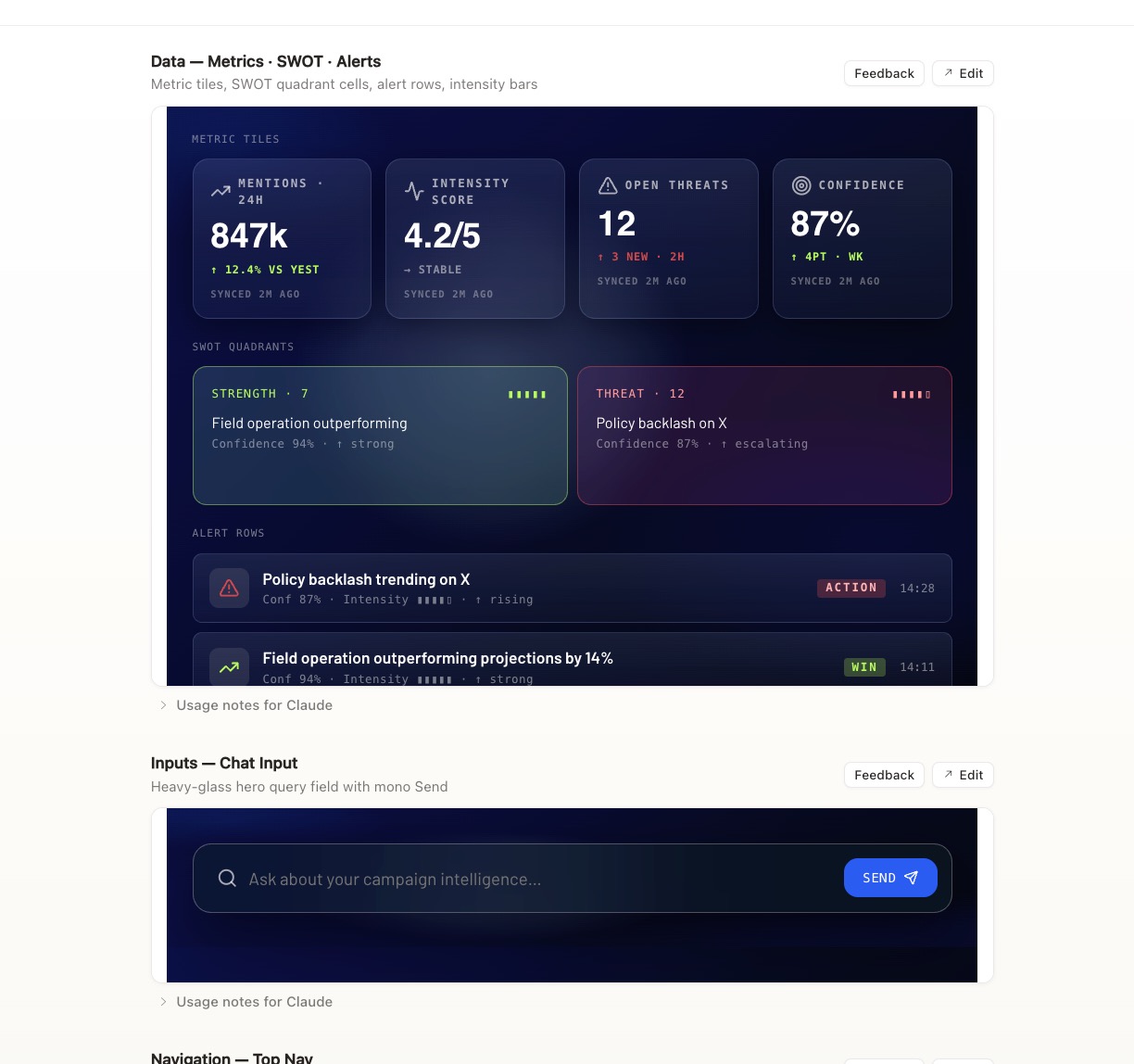
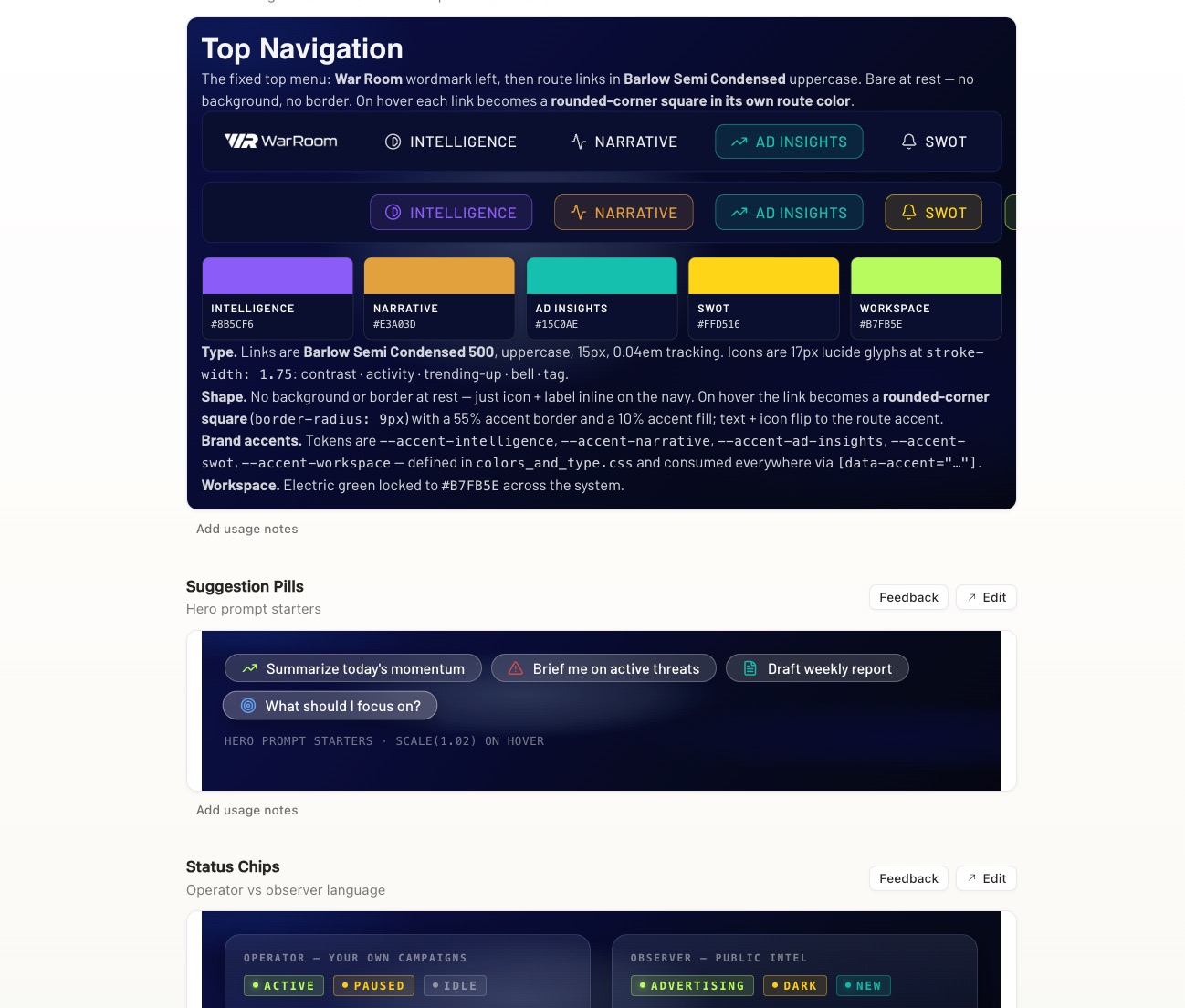
Designed, not defaulted.Before a line of code: a full design system — metric tiles, SWOT quadrants, alert rows, chat input, navigation — authored by the same operator who wrote the backend. The product looks like it was designed because it was.
Use case
Six hats. One operator.
Engineering, design, marketing — War Room was built by one person wearing all of them. No hand-offs, no telephone game between the person who designs it and the person who ships it.